Blog
Beyond Smart Buildings: Empowering Truly Living Places with AI

Artificial Intelligence (AI) is no longer just a buzzword. In smart buildings, it represents a real technological opportunity — one that enables prediction, optimization, anomaly detection, and improved human experience.
At Trigrr, we are passionate about technology when it creates real value for the people who live, work, and operate in buildings. That’s why we asked ourselves a simple question: where can AI create the biggest impact on smart buildings — today and tomorrow?
What emerged is a clear vision: AI as a connector, an accelerator, and an assistant — not a replacement — for humans and existing building technologies.
#1
Where Can AI Create the Most Value?
One of AI’s biggest promises lies in how people interact with buildings. AI can simplify access to complex technologies by translating human intent—expressed naturally through language, behavior, or context — into building actions across systems like HVAC, lighting, and energy management.
At the same time, AI enables buildings to communicate back to users. By analyzing real-time and historical data, AI can provide relevant insights, proactive suggestions, and automatic adjustments — improving comfort, efficiency, and sustainability while anticipating needs rather than simply reacting to commands.
In this two-way relationship, buildings shift from passive infrastructure to intelligent partners that both respond to people and actively support better decisions and experiences.
“Everyone becomes smarter with AI,” says Ruben Merlevede, Business Development Manager at Trigrr. “It helps ensure the building matches users’ needs and dramatically reduces support tickets.”
Trigrr already connects every stakeholder within a building ecosystem. With an AI layer built on top of Trigrr, the platform becomes even more powerful. Facility managers add a predictive insight on top of their proactive reaction to issues, tenants benefit from a personalized experience without needing to make requests, and operators can process and leverage larger volumes of data to continuously optimize building performance and usage. Integrators focus on high-value expertise, and owners gain the insight and precision needed to unlock the full potential of their asset portfolio.
AI also opens new ways of working with spaces that were previously static or rigid, enabling hyper-personalized experiences. Buildings evolve from reactive systems into intelligent environments that continuously adapt to people, usage, and context.
Energy optimization is another major use case. As Matthew Deacon, Business Developer at Trigrr, explains, AI can predict and control real-time energy consumption, making it easier to integrate renewable energy sources and reduce waste.

#2
Turning AI’s Potential into Real Building Actions
Buildings are already filled with hardware and software. To unlock AI’s full potential, these technologies must be able to communicate seamlessly.
This is exactly where Trigrr’s semantic layer comes into play. “Trigrr Source provides the contextual foundation AI needs to understand and control buildings. The Building Operating System becomes the ‘arms and hands’ of the human–AI brain, turning ideas into real and proactive actions.” Jean-Michel Verhulst, CEO of Trigrr.
AI also supports faster deployment and easier operation. Advanced scenarios, dashboards, and reports can be configured through simple prompts, reducing manual work and making building control more intuitive — even for non-technical users.
A well-trained AI can also detect anomalies, suggest corrective actions, and generate clear reports. Combined with predictive data, this opens the door to preventing issues before they happen — a real game-changer for facilities teams.
#3
Your New Building Assistant
Imagine a building you can simply talk to. Through interfaces like WhatsApp, Teams, or other connected tools, users can request information or actions — tailored to their role and responsibilities.
This assistant considers far more than sensor data alone. By correlating multiple building data at the same time with user behavior, weather, events, calendars, and other contextual information, AI can improve return on investment, simplify operations, increase comfort, and reduce energy consumption.
AI can even act as a digital secretary for maintenance teams, optimizing intervention schedules based on real usage. Frequently used equipment is prioritized, while less critical assets require fewer interventions — resulting in less downtime, fewer visits, and lower costs.
At portfolio scale, Matthew Deacon highlights a key strength: “The ability to automate using so many variables is unique. Data removes guesswork, and easy implementation makes it simple to visualize impact and adjust quickly.”
#4
Is AI the Answer to Everything?
The short answer is: no.
“Artificial Intelligence only works well when the problem is clearly defined, and the data is reliable,” explains Christophe Penninckx, CTO at Trigrr. “Without proper scope and calibration, it can amplify bias, make wrong assumptions, or behave unpredictably.”
Many challenges are still better solved with deterministic automation rules, where outcomes are transparent and predictable. Security, data protection, traceability, and human oversight remain essential.
At Trigrr, we see AI as an assistant, not a replacement. Our goal is to build virtual employees that handle repetitive, analytical, or optimization tasks — allowing humans to focus on creativity, strategy, and decision-making.
AI enhances work; it doesn’t define it.
Our goal is to create living buildings where technology enhances infrastructure in service of human comfort and well-being.
#5
Where Trigrr Stands Today
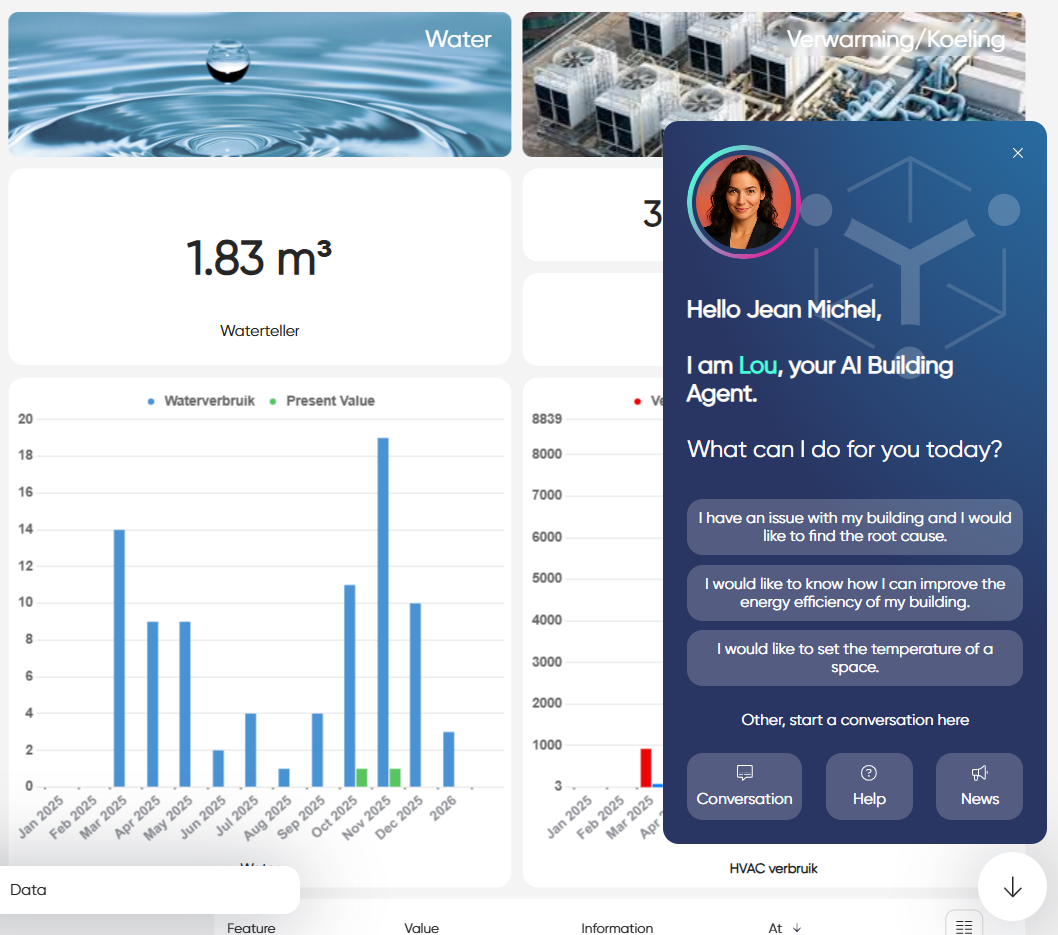
We already leverage AI to facilitate configuration and support users through our building agent, Lou. Today, more than half of our R&D investment is dedicated to AI, driving exponential gains in the value and efficiency of our Building Operating System.
We have laid the foundations for AI agents that understand building data, interact with systems, and support decision-making. The next step is enriching them with high-quality environmental, operational, and behavioral data to ensure recommendations are contextual and reliable.
We’re also extending their capabilities beyond analysis to controlled actions within the building. AI agents will be able to request live data from connected devices, adjust parameters within predefined safety limits, and collaborate with automation rules for optimization. This evolution transforms AI from a passive observer into an active assistant — a digital workforce that helps operate, predict, and enhance building performance while maintaining full transparency and human supervision.
Conclusion: Smarter Buildings, Smarter Collaboration
“AI will not replace humans, hardware, and emotional experiences — but it will fundamentally change how they work together and increase their value,” concludes Jean-Michel.
By reducing friction, revealing insights, and accelerating action, AI enables buildings that are more efficient, more comfortable, and more human-centric.
At Trigrr, we believe the future of smart buildings isn’t just automated — it’s intelligent, assistive, and collaborative. A truly living building doesn’t ask people to adapt to technology; it adapts continuously to people.